Kilimanjaro Rongai Route 8 Days

Mount Kilimanjaro, Tanzania

Kilimanjaro Rongai Route 8 Days

Mount Kilimanjaro, Tanzania

Price

$1,800.00

Duration

8 days

Max People

24

Min Age

16+

Overview

The 8-day Kilimanjaro Rongai Route is a northern approach that offers trekkers a quieter and less crowded path to Africa’s highest peak. Unlike other routes, it is less affected by rain, allowing for clearer skies and a better chance to spot wildlife, including monkeys, antelopes, and unique bird species in the lower forest zones. The extended itinerary provides gradual acclimatization, which increases the likelihood of reaching Uhuru Peak safely. With experienced guides, porters, and cooks, trekkers enjoy support at every stage, ensuring both safety and comfort while fully immersing themselves in the natural beauty of Kilimanjaro.

The climb begins at the Rongai Gate, moving through lush rainforest before ascending into moorland and alpine desert. Trekkers pass through scenic camps including Simba, Kikelewa, Mawenzi Tarn, and School Hut, following a gradual ascent that balances challenge with rest. Each day’s trek offers unique landscapes, from dense forests and wide plains to dramatic rock formations and glacial views. The summit night is the most demanding, beginning late at night to reach Kibo’s Uhuru Peak for sunrise. This experience provides panoramic views of the surrounding Tanzanian wilderness, making the effort both rewarding and unforgettable.

The descent follows the southern Marangu route, creating a loop that exposes climbers to varied terrain and ecosystems. After returning to the trailhead, trekkers transfer to Moshi or Arusha for departure or optional safari experiences. The Rongai Route’s design prioritizes acclimatization, higher summit success, and minimal crowding, making it ideal for first-time climbers and experienced trekkers alike. Combining adventure, stunning scenery, and expert support, the 8-day Kilimanjaro Rongai Route delivers a fully immersive, safe, and rewarding trekking experience that highlights the natural and cultural richness of Tanzania.

Highlights:

  • Departure and Return Place: Moshi Town to Rongai Gate and return to Kilimanjaro International Airport (Google Maps).
  • Departure Time: Be ready by 8:15 AM for a prompt 9:30 AM departure.
  • Return Time: Approximately 10:30 AM on the final day.
  • Dress Code: Casual and comfortable athletic clothing, hiking shoes, hat, cold-weather jacket, gloves, pants, and spare clothing.
  • Accommodation: Two nights at a 3-star hotel with Bed and Breakfast; upgrades available on request.
  • Customizations: Fully customizable to suit traveler preferences.
  • Extensions: Trip extensions available on request.
  • Season: Trek is available year-round.
  • Fitness Level: Suitable for moderate fitness with prior trekking experience.

8-Day Kilimanjaro Rongai Route Itinerary

Day 1: Arrival in Arusha

Arrive at Kilimanjaro International Airport (JRO) and transfer to your hotel in Arusha for a briefing and preparation for the trek.

Day 2: Rongai Gate to Simba Camp

Drive to Nalemuru (Rongai) Gate, register, and begin trekking through the conifer forest to Simba Camp on Kilimanjaro’s northern slope.

Day 3: Simba Camp to Second Cave

Trek continues through the forest zone to Second Cave Camp, enjoying wilderness views and spotting wildlife along the trail.

Day 4: Second Cave to Kikelewa Cave

Exit the forest into the moorland zone with expansive mountain views and opportunities to see animals such as jackals and buffalo.

Day 5: Kikelewa Cave to Mawenzi Tarn

A shorter climb to Mawenzi Tarn, a stunning campsite beneath Mawenzi Peak, allows time for acclimatization and photography.

Day 6: Mawenzi Tarn to Kibo Hut

Cross the barren saddle and ascend to Kibo Hut, preparing for the ultimate summit attempt the following day.

Day 7: Summit (Uhuru Peak) & Descent to Horombo Hut

Begin a pre-dawn climb to Uhuru Peak (5,895 m) for sunrise, then descend to Horombo Hut for rest.

Day 8: Morombo Hut to Marangu Gate & Departure

Descend through the heath and forest zones to Marangu Gate, then transfer back to Kilimanjaro International Airport for departure.

Why Choose the 8-Day Kilimanjaro Rongai Route?.

  • Less Crowded: The northern approach is less traveled, providing a peaceful and secluded climbing experience.
  • Rain Shadow Effect: Located in Kilimanjaro’s rain shadow, it’s ideal during the rainy season with clearer skies.
  • Wildlife Spotting: Passes through rainforest zones where trekkers may see primates, jackals, and buffalo.
  • Acclimatization: The 8-day itinerary allows extra time for gradual acclimatization, improving summit success.
  • Gradual Ascent: The gentle incline makes it suitable for hikers with limited backpacking experience, combining safety and adventure.

Costs Includeds/Excludes

  • Two way private airport transfers
  • All park fees collected by the National Park
  • Hotel ccommodations one night before and one night after the expedition
  • Tented accommodation on Mount Kilimanjaro
  • All meals on the hike
  • All group equipment (dining tent, table, chairs, crockery and cutlery)
  • Oxygen cylinders and oximeters
  • Complete Expedition medical kits
  • Professional guides licensed by Kilimanjaro National Park
  • Dedicated support crew (assistant guides, camp master, porters, cooks, etc.)
  • Government taxes
  • Crew salaries
  • Medical evacuations with AMREF Flying doctors
  • Purified water while on the mountain
  • Portable tented private flush toilet
  • Personal Climbing gears
  • Tanzania Visa on arrival
  • Mountaineering Insurance
  • Tips and Gratuities
  • Personal Expenses (e.g. laundry, telephone, beverages, etc.)

Day 1 Arrival in Tanzania

On your arrival at Kilimanjaro International Airport a member of our staff will be at holding a Nihapa Tours placard. You will then be transferred to your hotel for an overnight stay.

Day 2 Rongai Gate (1950m) – 1st Caves Camp (2600m)

After an early breakfast at your hotel, you will be picked up from Arusha or Moshi and driven to the Marangu Gate (1980m). At the gate, the porters will organize and pack the belongings for the hike while you and your guide register with the Tanzania National Park (TANAPA). You will then be transferred by vehicle to the Rongai trailhead, which is 2.5 hours away from the Managu Gate. The trail begins in the tall cornfields then leads into the pine forest. This trail has a gradual ascent and allows hikers to enjoy their surroundings. About halfway up the trail you will have a lunch break and you will reach the 1st Caves Camp (2600m) in the late afternoon or early evening. The porters and chef, who move very fast up the mountain, will reach camp before you and set up your tents, boil drinking water, and prepare snacks for your arrival. After washing up, a hot dinner will be served. For overnight, mountain temperatures may drop to freezing so be prepared!

Hiking time: 5 hours
Distance: Approximately 8 kilometers
Habitat: Montane Forest

Day 3 1st Caves Camp (2600m) – Kikelewa Cave (3600m)

Following a hot breakfast, hikers will continue their ascent to Kikelewa Cave (3600m). The trail passes Second Cave (3450m) and this is a good spot to take a lunch break. Similar to the first night, your tents will be set up prior to arriving at camp and the porters will prepare drinking and washing water for you. You will enjoy evening snacks and then dinner prepared by our chef. Be prepared for a cold night as temperatures drop below freezing at this exposed camp.

Hiking time: 6-7 hours
Habitat: Moorlands

Day 4 Kikelewa Cave (3600) – Mawenzi Tarn Camp (4330m)

On this day, hikers will enjoy a short, yet steep trail to Mawenzi Tarn Camp (4330m). In the moorland, you will spot exotic plants, including giant lobelia and groundsel. At camp, hikers will enjoy spectacular views and allow their bodies to acclimate. Hot dinner and washing water will be prepared for hikers as they enjoy the magnificent sunset.

Hiking time: 3-4 hours
Habitat: Moorlands

Day 5 Mawenzi Tarn Camp (4330m) – Kibo Hut (4700m)

After breakfast, hikers will continue ascending east for a half-day hike to Kibo Hut. Kibo is located in the “Saddle,” which refers to the area located between the peaks of Mawenzi and Kibo in an alpine desert. There is no water at this camp, but hikers can buy mineral water and soft drinks at the camp office. An early dinner will be served so hikers can rest before attempting the summit the same night. Your guide will brief you in detail on how to prepare for summit night. Get to sleep by 19:00!

Hiking time: 4-5 hours
Habitat: Alpine desert

Day 6 Summit Attempt Kibo Hut (4700m) – Uhuru Peak (5895m) – Horombo Hut (3720m)

Your guide will wake you around 23:30 for tea and biscuits. You will then begin your summit attempt. The trail is rocky up to Hans Meyer Cave (5150m). You continue your ascent to Gillman’s point (5681m). Reaching this section is an impressive achievement as the trail is steep, rocky, and at a high altitudes. Gillman’s is located on the crater rim. From this point, you will usually experience a snow covered trail until you reach the summit, Uhuru Peak (5895m). Reaching the summit of Mt. Kilimanjaro is a lifetime accomplishment! You will be able to spend a short time on the summit taking photographs and drinking tea before the descent to Barafu begins. The hike down to Kibo Hut takes about 3 hours.
At Kibo Hut, you will rest and enjoy a hot lunch in the sun. After eating, you will continue descending down to Horombo Hut (3720m). You will have a dinner, wash, and rest soundly at the hut after a strenuous day.

Hiking time: 8 hours to Uhuru and 6 hours to Horombo
Habitat: Stone scree/ice-cap summit
Distance: Approximately 6 kilometers ascent and 21 kilometers descent

Day 7 Horombo Hut (3720m) – Marangu Gate (1980m)

Following a well-deserved breakfast, your staff will have a big celebration full of dancing and singing. It is here on the mountain that you will present your tips to the guide, assistant guides, chef(s), and porters. After celebrating, you will descend for 6 hours back to Marangu Gate (1980m). The National Park requires all hikers to sign their names to receive certificates of completion. Hikers who reached Gillman’s Point (5681m) receive green certificates and hikers who reached Uhuru Peak (5895m) receive gold certificates. After receiving certificates, you will drive back to Moshi in your hotel.

Hiking time: 6 hours
Distance: Approximately 27 kilometers

Day 8 Depart Tanzania

Depart Tanzania or continue your dream with amazing safari extensions.
For trekkers not continuing with a safari, we provide transfers to Kilimanjaro International Airport or bus station for your onward journey.

Tour Pricing

Number of People Cost Per Person in Mid-Range Cost Per Person in VIP
1 person $2,950 $6,400
2 people $2,100 $5,900
3 people $2,990 $5,400
4 people $2,990 $5,200
5 people $2,050 $5,000
6 people $2,000 $4,800
7 people $1,950 $4,600
8 people $1,910 $4,400
9 people $1,850 $4,200
10 people + $1,800 $4,000

Tour Accommodations

Mid-Range  Package VIP (Luxury) Package
Two Nights Accommodations on BB at either of the following Ameg Lodge or Salinero Hotels Two Nights Accommodations at Mount Meru Hotel on FB or at Gran Melia Hotel

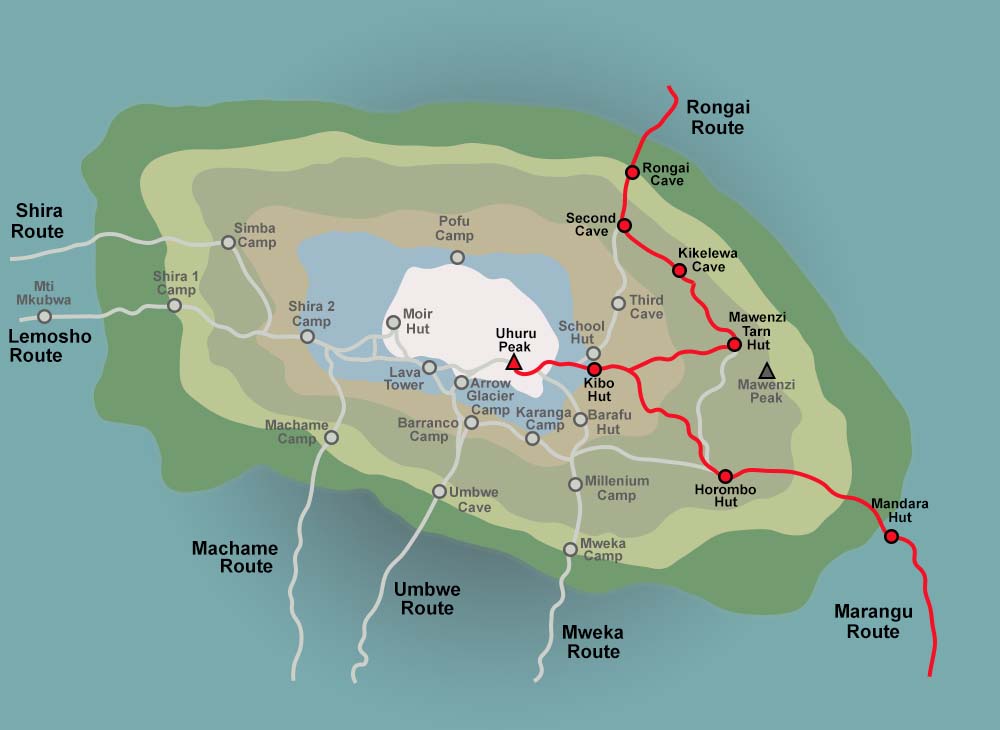
Tour Map

Are there charging stations on Mount Kilimanjaro?

There are no charging stations on Mount Kilimanjaro. We recommend bringing Power Banks and spare batteries. There are charging ports in our safari vehicles.

Who are your operators in Tanzania?

We are. We are not agents for anybody, but run the treks ourselves through our own Tanzanian company. So you can rest assured that whoever you speak to in our company has climbed Kilimanjaro – and probably many times.

What travel documents do I need?

You will need a passport that is valid for at least six months beyond your dates of travel with an entry or re-entry visa, duly endorsed.

What kind of food will I eat on Kilimanjaro?

Highly-trained chefs prepare three hot nutritious meals daily, as well as trail snacks and afternoon tea each day. You’ll eat all your meals in a solar-lit dining tent with your fellow trekkers and head guide. Delicious vegetarian, vegan, gluten-free and other specialty meals can be provided (with advance request). We’re happy to send you a sample menu—just ask!

What kind of hiking experience do I need?

None, but previous hiking or climbing experience will help. You need to be fit and healthy and have a good pair of worn-in hiking boots. The fitter you are the more you are likely to enjoy it.

What if I have special dietary requirements?

Vegetarian, vegan, gluten-free, celiac, lactose-free, or if you have any allergies, just give us a heads up and you will be catered to.

What are the Kilimanjaro accommodations like?

Your mountain camps are set up and broken down each day by expert camp porters. You’ll stay in double occupancy all-weather tents with full-ground pads to keep you and your gear dry. Private toilet tents, solar-lit dining tents with tables and chairs, and basins of hot water for washing are provided in every camp. Grand Traverse treks include upgraded solar-lit walk-in-height sleeping tents with mountaineering beds and mattresses for additional comfort.

What about solar protection?

Tanzania is very near to the equator. So the sun is always at its acme for most of the day. The sun can be fierce and cause sunburns and sunstroke. Wear a hat, shades, and use SPF sunblock lotion

I would like to book but I have group is large group, is this a problem?

We aim to keep the size of the public groups to a minimum, as we feel that a group that is much larger than ten trekkers is cumbersome and trekkers lose the sense that they are in a wilderness if there are too many people. That said, if you are a single, private group, then there is no problem accommodating you whatever the size of the group, as, of course, you will be aware before arriving in Tanzania of the number of people you will be trekking with.

How many hours will I trek each day?

On most routes, you’ll trek 4-7 hours most days. On certain routes you’ll trek as many as 10-15 hours on the longest days.

How long is the Kilimanjaro hike?

There are at least six routes to the top, of Uhuru peak. You will hike between 53 and 73km depending on which route you choose. The shortest and toughest is the 5-day Umbwe route. Allowing extra days will help you to acclimatize better and improve your chances of reaching the summit. The easiest and most popular route is Marangu (which can be done in five), but we use six days for this route.

How high is Kilimanjaro?

Mount Kilimanjaro is the highest freestanding mountain in the world and the highest mountain in Africa. Its highest point is Uhuru Peak on the Kibo crater at 5895m above sea level.

Do You Offer Private and Fully Customizable Climbs For Kilimanjaro

Your Kilimanjaro dream climb is entirely your own to design. We will work with you to customize exactly the triumphant Tanzanian mountainous quest experience you want. You go with the people you choose. You leave on whatever day you wish. You decide on your preferred route option, pace, and the number of days you will take.

Do You Offer Crater Camp Option On Kilimanjaro Climbs

An overnight stop at Crater Camp is an optional extra on any customized Kilimanjaro climb, usually lasting eight actual mountain days or more on the Shira, Lemosho, Umbwe, and Machame routes. Possibly the most bizarre place you will ever see, it is visited by less than 5% of the 40,000 to 50,000 people who annually ascent Kilimanjaro on a distinct highlands voyage in northern Tanzania

Do you arrange Airport pick-up and Drop off?

All our tours to mount Kilimanjaro climbs include airport transfers. We pick you up at Kilimanjaro International Airport (JRO) or any other airport near Arusha and Kilimanjaro as per your itinerary plan and take you to your pre-climb hotel in Moshi or Arusha, then back again at the end of your itinerary. In short, we take care of your air transfers and accommodation, before and after your Mount Kilimanjaro climb.

Do we tip the hiking crew?

Yes, it is expected and much appreciated. The amount depends on the number of days, but can range from $150 and $300 per hiker. Tips are pooled and shared amongst the crew. Bring US dollar bills.

When is the best time to climb Kilimanjaro?

Mount Kilimanjaro can be climbed anytime throughout the year. Most travelers prefer climbing during the dry seasons: December to March, June to October. Many consider the best months to climb Kilimanjaro to be January, February, and September.

Book This Tour

please, select date first

Chat to a Safari Specialist!
WhatsApp

Why Book With Us?

See our Review Us On

Login

Nihapa Tours is a sustainable, family-owned Boutique Tour Operator based in Arusha, Tanzania.

Proudly Tanzanian-owned and deeply rooted in local expertise, our multicultural team combines the passion of our primarily Tanzanian staff with fresh global perspectives from our expatriate collaborators who share an unwavering dedication to showcasing the wild beauty of our homeland.

We’re dedicated to delivering personalized, world-class safari experiences infused with genuine African hospitality & Sustainability. We offer Luxury safari and Beach vacation trips to Tanzania and Zanzibar, Camping safari, and Adventure trips to Serengeti, Kilimanjaro, and the whole of East Africa.

Address

Meru Spring Plaza, Box 13287, Arusha Tanzania, Plot 690 Block D, 23106.

Phone

Email