
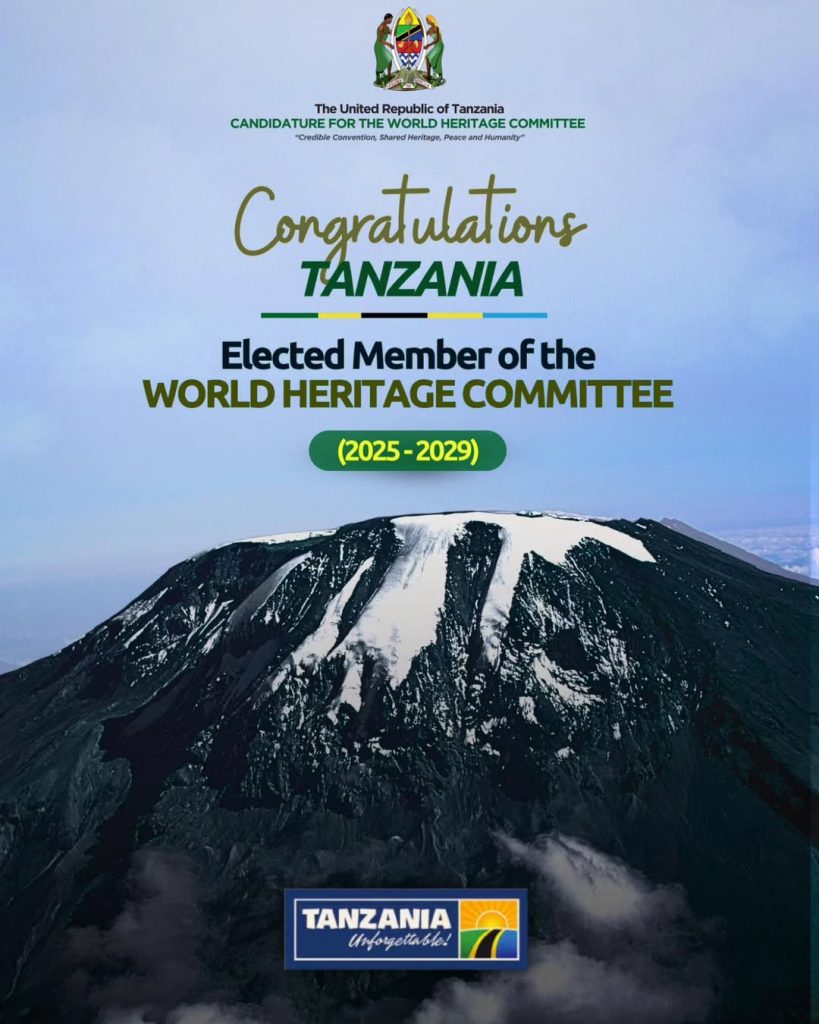
PARIS: Tanzania has secured a prestigious seat on the World Heritage Committee, elected for a five-year term from 2025 to 2029.
The election took place during the 25th Session of the General Assembly of States Parties to the World Heritage Convention at UNESCO Headquarters in Paris, where Tanzania won the position in the first round. This early victory reflects the strong international confidence placed in Tanzania’s long-standing commitment to safeguarding natural and cultural heritage.
The 1972 World Heritage Convention remains the most influential global framework for protecting sites of outstanding universal value. It uniquely brings together nature conservation and cultural preservation within a single system, recognizing the deep relationship between communities, their history, and the environment that surrounds them. Through this Convention, countries define the types of natural or cultural properties that may be considered for inscription on the World Heritage List and commit to identifying, protecting, and promoting them for future generations.
Tanzania’s Existing UNESCO World Heritage Sites
Tanzania already holds a respected position in global conservation, with several sites acknowledged for their exceptional universal value. Serengeti National Park is celebrated worldwide for the Great Migration and its vast ecosystems. Kilimanjaro National Park encompasses Africa’s highest mountain and its remarkable ecological zones.
The Ngorongoro Conservation Area presents an extraordinary combination of wildlife, landscapes, and archaeological heritage. The extensive Selous Game Reserve, now part of Nyerere National Park, stands among the largest protected areas in Africa. Stone Town of Zanzibar embodies centuries of cultural exchange, while the Kondoa Rock-Art Sites preserve ancient expressions of early human creativity. These places reflect Tanzania’s rich natural beauty and cultural depth.
A Historical Legacy of Global Participation
Tanzania’s new appointment continues a long-standing tradition of active involvement in UNESCO’s heritage bodies. During the 20th General Assembly of the States Parties to the World Heritage Convention, held from 18 to 20 November 2015 in Paris under the chairmanship of H.E. José Filipe Mendes Moraes Cabral of Portugal, Tanzania was elected to the World Heritage Committee alongside Angola, Azerbaijan, Burkina Faso, Cuba, Indonesia, Kuwait, Tunisia, and Zimbabwe.
At that same session, Tanzania also became a member of the Bureau, working alongside Lebanon, Peru, the Philippines, and Poland. The 2015 assembly focused on key discussions related to the World Heritage Fund, the Global Strategy for a representative and credible World Heritage List, and broader reflections on the future of the Convention.
At the time, the World Heritage Committee was overseeing a List that included more than one thousand properties across 163 countries, comprising cultural, natural, and mixed sites. Tanzania’s renewed appointment from 2025 to 2029, therefore, reflects continuity, trust, and proven leadership within the global conservation community.
Impact and Significance of the 2025–2029 Appointment
By securing a seat on the Committee once again, Tanzania advances into a role of considerable influence. This position strengthens the country’s visibility on the global stage, allows it to help shape international heritage policies, and deepens opportunities for scientific collaboration and technical partnerships.
It also supports local capacity-building efforts and reinforces Tanzania’s ability to advocate for heritage priorities across Africa and the broader Global South. The appointment stands as recognition of Tanzania’s dedication to preserving both its natural landscapes and its cultural identity.
What This Means for Tourism and Conservation
The timing of Tanzania’s election aligns with a global shift toward sustainable tourism and long-term conservation planning. With iconic destinations such as Serengeti, Kilimanjaro, Ngorongoro, and Zanzibar attracting visitors from around the world, this appointment reinforces international trust in Tanzania’s stewardship of its heritage.
It strengthens awareness among travelers, encourages responsible tourism practices, and supports the integration of heritage protection into community development. In the long run, this milestone contributes to a balanced vision in which conservation, cultural preservation, and tourism advancement work together for the benefit of the nation and its people.
Read More News From Our Source, UNESCO