Key Takeaways
- For late February safaris, choose Ndutu for the wildebeest calving season, while Central Serengeti is better for broader wildlife experiences.
- Ndutu offers concentrated wildlife viewing, newborn calves, and predator interactions, making it ideal for migration-focused travelers.
- Central Serengeti offers excellent resident wildlife year-round and still provides good wildlife viewing even without the migration as the focus.
- Travelers can combine both areas to experience the calving season and enjoy diverse landscapes and habitats.
- Booking in advance is essential during peak migration seasons, especially for high-demand accommodations.
Ndutu or Central Serengeti in Late February? Where Should You Stay?
If you are visiting Tanzania in late February and want to see the Great Migration, one of your biggest decisions is where to stay: Ndutu or Central Serengeti?
For travelers interested in the wildebeest calving season, Ndutu is usually the more logical base because the herds concentrate around the southern Serengeti and Ndutu area during this period. Central Serengeti can still offer excellent wildlife viewing and is worth considering if your safari priorities extend beyond the migration.
The right choice ultimately depends on what you want from your safari.
Quick answer: Ndutu or Central Serengeti?
If your main goal is to experience the wildebeest calving season, choose Ndutu.
If you want a broader Serengeti safari with access to resident wildlife, predators, and the central Serengeti ecosystem, Central Serengeti can make more sense.
For a late-February safari focused on the Great Migration, we generally recommend spending at least part of the itinerary in or near Ndutu, rather than basing the entire safari in Central Serengeti.
TANAPA lists January and February as the Serengeti’s calving season, while its migration information describes the short-grass plains around the southern Serengeti as an important calving area.
Table of contents
- Ndutu or Central Serengeti in Late February? Where Should You Stay?
- Quick answer: Ndutu or Central Serengeti?
- Why Ndutu is important in late February
- Ndutu vs Central Serengeti in late February
- What can you see around Ndutu in late February?
- What is Central Serengeti like in late February?
- So, should you stay in Ndutu or Central Serengeti?
- Is Ndutu always better in late February?
- What about staying in Central Serengeti and driving to Ndutu?
- Where should couples and honeymooners stay?
- Where should families stay?
- What should you book for late February?
- Our approach to late-February Tanzania safaris
- Ndutu or Central Serengeti: the final decision
- Frequently Asked Questions
- Planning a late-February Tanzania safari?
Why Ndutu is important in late February
The Great Migration is not simply a herd moving from one fixed location to another. The animals move through the Serengeti ecosystem according to rainfall, fresh grass, breeding, and calving conditions.
During the calving season, large numbers of wildebeest gather on the nutritious short-grass plains of the southern Serengeti and surrounding Ndutu area.
This makes late February particularly interesting for travelers who want to see:
- Large concentrations of wildebeest
- Newborn wildebeest calves
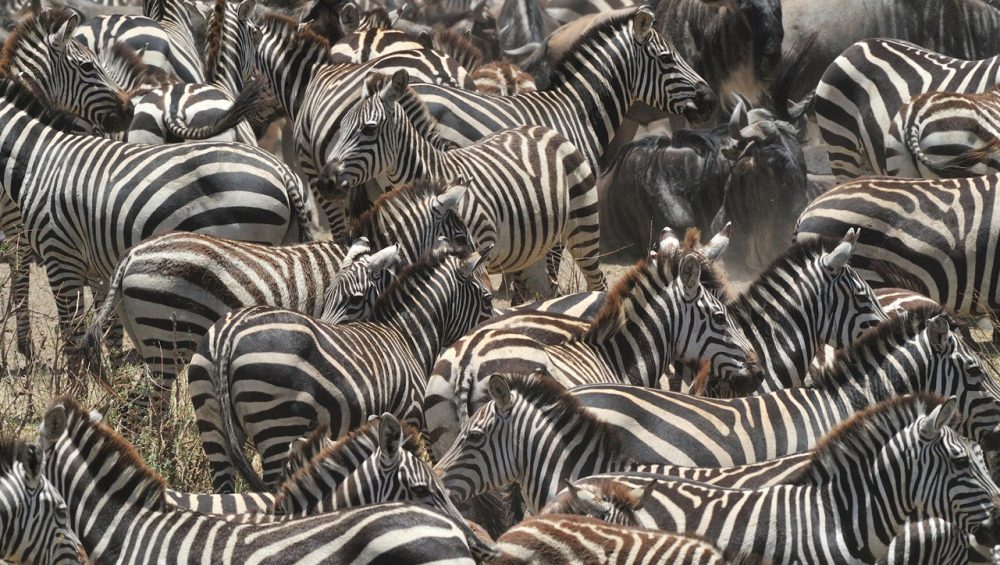
- Zebras and other grazing animals
- Lions and other predators following the herds
- Predator-prey interactions
- The wider spectacle of the calving season
TANAPA notes that hundreds of thousands of wildebeest calves are born during the annual calving period, with most born within a relatively short period around mid-February.
That does not mean every day in late February will look exactly the same. Wildlife movements are natural and can vary with rainfall and local conditions.
Ndutu vs Central Serengeti in late February
| Attraction | Ndutu | Central Serengeti |
|---|---|---|
| Main attraction | Calving-season migration | Year-round Serengeti wildlife |
| Late February migration | Excellent area to consider | Migration may be less concentrated |
| Wildebeest calves | Strong opportunity | Possible, but less focused on calving concentrations |
| Predator viewing | Excellent | Excellent |
| Resident wildlife | Good | Excellent |
| Migration-focused safari | Very suitable | Less focused |
| First-time Tanzania safari | Excellent if migration is the priority | Excellent for a broader Serengeti experience |
| Best for | Travelers prioritizing calving season | Travelers wanting broader Serengeti coverage |
The important point is that Central Serengeti does not become a poor safari destination in February.
Serengeti National Park supports a wide range of habitats and wildlife throughout the year, including lions, leopards, elephants, buffaloes, rhinos and many other species.
The difference mainly comes down to what you want to see and how you want to structure your safari.
What can you see around Ndutu in late February?
Ndutu is particularly attractive during calving season because the concentration of grazing animals creates opportunities for predator sightings.
You may encounter:
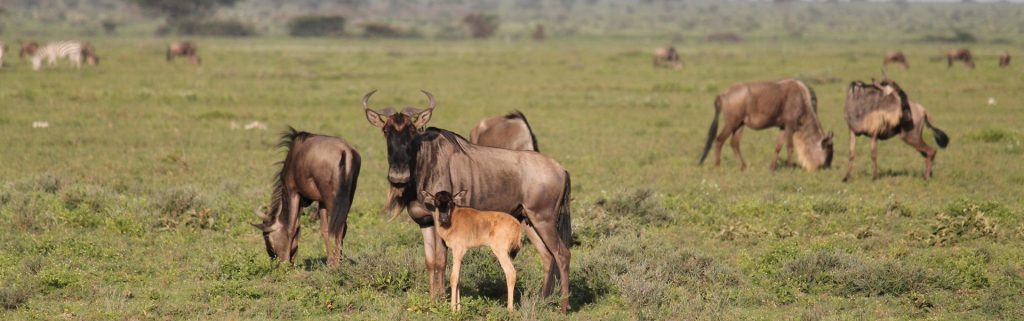
Wildebeest and newborn calves
The calving season is the main reason many travelers choose Ndutu in January and February.
Watching newborn calves take their first steps across the short grass is one of this period’s defining experiences.
Lions
Where large concentrations of young prey animals gather, predators are also active.
Lions are among the species travelers hope to encounter around the calving grounds.
Cheetahs and other predators
You may also encounter cheetahs, hyenas, and other predators during this period.
However, wildlife is wild, and sightings can never be guaranteed.
Zebras and gazelles
The migration involves more than wildebeest. Zebras and other grazing animals move through the ecosystem alongside the herds.
What is Central Serengeti like in late February?
Central Serengeti, particularly the Seronera area, is one of the park’s most important wildlife-viewing regions.
It is known for open plains, rocky kopjes, riverine areas, and habitats that support resident wildlife.
This means that even if the migrating herds are concentrated farther south, Central Serengeti can still produce an excellent game-viewing experience.
It may be particularly attractive if your priorities include:
- Lions
- Leopards
- Elephants
- Buffalo
- Resident herbivores
- Diverse landscapes
- A broader Serengeti experience
TANAPA describes the Serengeti as having a variety of habitats, including open grasslands, riverine forests, swamps, woodlands and kopjes, which support a diverse wildlife population.
So, should you stay in Ndutu or Central Serengeti?
The simplest way to decide is to start with your main safari objective.
Choose Ndutu if:
Your number-one priority is the Great Migration calving season.
This is especially relevant if you are traveling in late February specifically to see the wildebeest herds, newborn calves, and predator activity around the calving grounds.
Choose Central Serengeti if:
You want a broader Serengeti wildlife experience rather than concentrating your safari around the calving grounds.
Central Serengeti can be a strong choice for travelers who want to explore a wider range of habitats and look for resident wildlife.
Choose both if:
You have enough time to experience both areas.
For many travelers, this is the most useful approach.
Instead of treating Ndutu and Central Serengeti as competing destinations, you can use them for different purposes within the same safari.
For example:
2 nights Ndutu + 2 nights Central Serengeti
can give you time to experience the calving-season area while also exploring the central Serengeti.
The exact number of nights should depend on your arrival route, departure point, budget, and overall safari length.
Is Ndutu always better in late February?
Not necessarily.
This is an important distinction.
Ndutu is particularly relevant during the calving season, but wildlife movements are not controlled by a calendar.
Rainfall and the availability of fresh grazing influence where the herds concentrate.
So no one can responsibly guarantee that the migration will be directly outside your camp on a particular date.
This is why choosing an experienced local safari operator and having a guide who can adapt the game-drive plan to current wildlife movements matters.
The Serengeti is a dynamic ecosystem, not a fixed wildlife attraction.
What about staying in Central Serengeti and driving to Ndutu?
This is possible, but you should consider it carefully.
The question is not simply whether a vehicle can drive from one area to another. It is how much time you want to spend traveling between wildlife areas versus watching wildlife.
If your primary objective is the calving season, staying closer to the area where the herds are concentrated can reduce unnecessary daily driving.
This is one reason accommodation location matters so much during migration-focused safaris.
A lodge or camp that looks inexpensive or convenient on a map may not provide the same practical access to the wildlife area you want to explore.
Where should couples and honeymooners stay?
For couples traveling in late February, the answer depends on the experience you want.
If you want to wake up close to the migration and spend your days following wildebeest herds and looking for newborn calves, Ndutu is the more migration-focused choice.
If you want a broader luxury safari experience with more time exploring Central Serengeti’s landscapes and resident wildlife, Central Serengeti may be a better fit.
For a longer honeymoon safari, combining both areas can create more variety.
Where should families stay?
Families should consider more than migration location.
Look at:
- Driving time
- Camp and lodge facilities
- Family accommodation
- Meal arrangements
- Children’s policies
- Vehicle comfort
- Game-drive duration
- Distance between destinations
If the family is traveling specifically for the calving season, Ndutu can be a compelling base.
If the family wants a broader introduction to the Serengeti, Central Serengeti can offer a wider wildlife experience.
What should you book for late February?
Late February falls within one of the most sought-after periods for travelers interested in the Serengeti’s calving season.
Accommodation close to the migration areas can therefore be limited, particularly for travelers looking for high-end camps.
It is worth planning the accommodation and route together rather than choosing a camp first and building the safari around it later.
Your safari operator should consider:
- Your exact travel dates
- Current migration patterns
- Accommodation location
- Road conditions
- Number of nights available
- Your wildlife priorities
- Whether you want Ndutu only or Ndutu plus Central Serengeti
TANAPA also recommends booking accommodation in advance during peak migration periods.
Our approach to late-February Tanzania safaris
At Nihapa Tours, we do not treat the Great Migration as a fixed itinerary where every traveler follows the same route.
For a late-February safari, we start by focusing on what you want to experience.
If calving season is the priority, we can build the itinerary around Ndutu and the southern Serengeti.
If you also want the wider Serengeti experience, we can combine Ndutu with Central Serengeti.
The aim is to spend your safari time where it makes the most sense for your travel dates and priorities, rather than choosing a location simply because it is popular.
Ndutu or Central Serengeti: the final decision
If you are traveling in late February specifically to see the Great Migration calving season, we would look at Ndutu first.
If your priority is a broader Serengeti safari with excellent resident wildlife and varied habitats, Central Serengeti remains an excellent option.
And if your itinerary allows enough nights, combining Ndutu and Central Serengeti can give you both experiences.
The key is not simply asking:
“Which area is better?”
Instead, ask:
“What do I most want to see during my safari?”
For calving-season migration: look closely at Ndutu.
For broader Serengeti wildlife: consider Central Serengeti.
For both: combine the two when your itinerary allows it.
Frequently Asked Questions
Is Ndutu better than Central Serengeti in late February?
If your primary objective is the wildebeest calving season, Ndutu is generally the more relevant area to consider. Central Serengeti remains excellent for broader wildlife viewing.
Is late February a good time to visit Ndutu?
Yes. January and February are recognized as the Serengeti’s calving season, making late February a particularly relevant period for travelers interested in the migration.
Can I see the Big Five from Ndutu?
Ndutu is part of the greater Serengeti ecosystem and offers excellent wildlife viewing, but no safari location can guarantee sightings of particular animals.
Should I stay in Ndutu for the entire safari?
Not necessarily. If you have enough time, combining Ndutu with Central Serengeti can provide a more varied safari experience.
How many nights should I spend in Ndutu?
There is no universal number. For a migration-focused safari, two or more nights can give you substantially more time to explore the area than a single overnight stop, but the ideal duration depends on your overall itinerary.
What is the best area of the Serengeti in February?
No single area is best for every traveler. For calving-season migration, the southern Serengeti and Ndutu area are particularly relevant. For broader wildlife viewing, Central Serengeti remains an important safari area.
Does the migration stay in Ndutu throughout February?
No. The migration is a natural movement of wildlife, and its exact location can change with environmental conditions. Treat published seasonal patterns as a guide, not a guarantee.
Planning a late-February Tanzania safari?
If you are deciding between Ndutu and Central Serengeti, tell us your travel dates, number of nights, and main wildlife priorities.
We can build the route around the experience you actually want, not a standard Tanzania safari itinerary.